
 The Animal Control Module
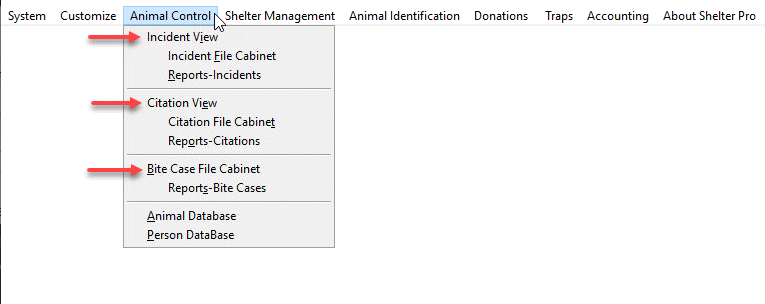
The Animal Control Module is designed to support the record-keeping and reporting needs of typical animal control departments. The module is found under the main menu item titled Animal Control and consists of these event types:
- Incident (aka Complaint, Dispatch, Service Call, etc.) record-keeping;
- Citation (aka Violation, Ticket, etc.) record-keeping;
- Bite Case record-keeping.
File Cabinets
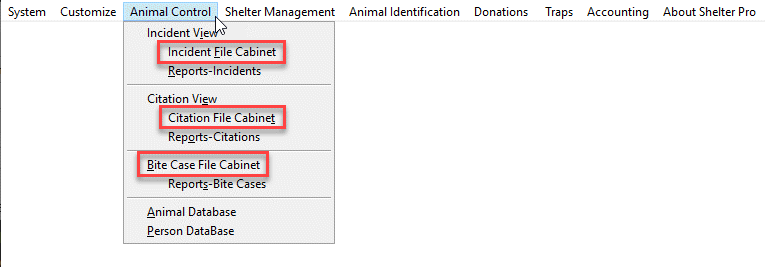
Each event type includes its own File Cabinet. File cabinets are the search and retrieve tool you'll use to look up records. For instance, to look up a previously recorded incident, use the Incident File Cabinet under the Animal Control Module main menu. Similarly, use the Citation File Cabinet under the Animal Control Module main menu to search for a previously entered citation. Or use the Bite Case File Cabinet under the Animal Control Module main menu to search for a previously entered bite case.
Reporting
Each event type includes it's own Report Generator. These include many predefined reports (commonly referred to as registers) that are needed by animal control agencies. For the animal control module, these include Incident Reports, Citation Reports, and Bite Case Reports.
Form generation
Each event type will include its own Forms. Forms can be printed, generated as a PDF, and/or emailed as appropriate. Some common forms for the animal control module would include an Incident Report, a Citation Report, or a Bite Case Report. Additionally there can be predefined custom form letters which can be generated as needed. The list above is not exhaustive of all forms, but at least it provides an idea of the more common form types available with this module.
Document Imaging
Each event type will support the retention of documents and images. Document imaging is a powerful tool in that it allows an organization to store necessary items in electronic form. In other words, document imaging helps organizations attain becoming a "paperless" environment. Some common examples of documents/images that can be stored electronically include scans of paperwork, images, and certain application generated documents such as Word documents, Excel spreadsheets, and others.
Documents/images are kept with their associated record which makes the retrieval of these items easy to locate and use. Each event type in Shelter Pro will have a documents tab where images are added and viewed as needed. When a particular event record is opened, simply click the 'Documents' tab to find any stored documents relevant to the particular record.
For the animal control module, some common uses of document imaging would include retaining things such as an image of a citizen's driver's license, images of paperwork provided by a pet owner or complainant that would be pertinent to a particular incident or citation, or court proceeding documentation associated with a prosecution. This list is not exhaustive, but should provide a good idea of some potential uses for document imaging.
Integration within the module
While each primary event type can be used independently, the animal control module includes certain critical integration features which provide a seamless connections with other primary events. For example, when an ACO is working on a particular incident, and the incident including issuing a citation to a citizen, the citation can, and should be connected to the incident because the two event types are related.
Another example would be when a bite case occurs. In these scenarios there will be an incident record, and connected to the incident record will be one or more bite reports (one for each bite victim).
Integration with the other modules
While each module can be used independently, the modules also include certain critical integration features which provide a seamless connections with other modules. For example, an incident which results in the impound of an animal provides functionality to connect a Shelter Management module case record to the Incident. When this is done, the information from the incident is automatically transferred to the shelter record saving valuable time and eliminating the potential for data inconsistencies due to data entry errors.
Another example would be when an animal is connected to an incident, the animal's Identification Module records are readily accessible from the incident record. This makes it very easy for the ACO to access the animal's status on licensing, rabies vaccination, microchip(s) and any other form of pet registration.
Next Topic
Comment or report problem with topic